
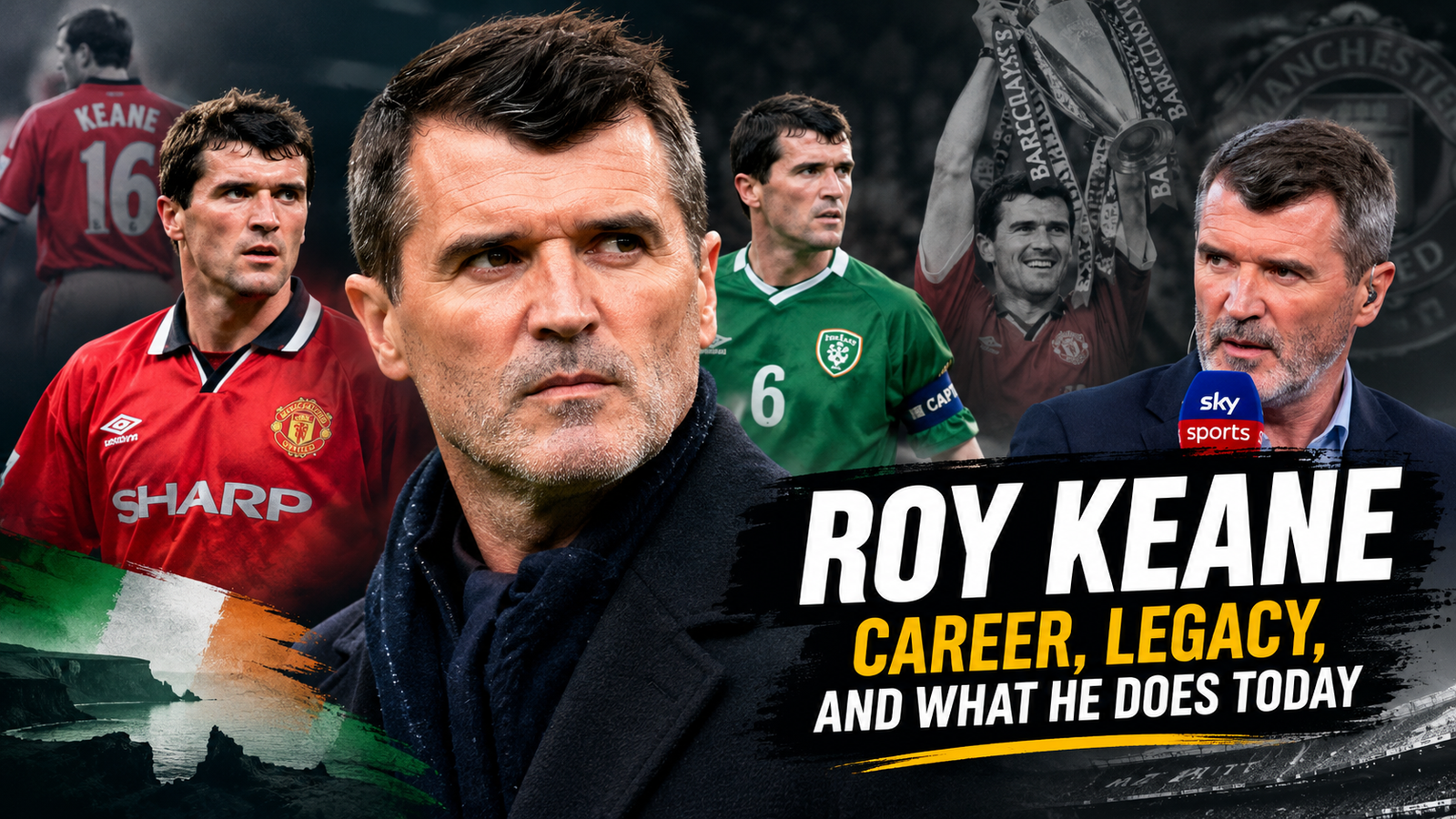
Roy Keane: Career, Legacy and What He Does Today
Roy Keane is the Irish midfielder who captained Manchester United through its most dominant years and later became one of the most recognizable voices in soccer television. If you grew up with the NFL or NBA, think of him as the player who wanted to win more than anyone else in the room, and said so loudly.
American fans got a close look at him this summer. The 2026 World Cup was hosted partly in the United States, and Keane worked it as a pundit. He also has a personal tie to US soccer: he played at the 1994 World Cup here. This guide covers his whole story, from Cork to the studio.
Table of Contents
- Quick Facts
- Early Life and Nottingham Forest
- Roy Keane at Manchester United
- Honours at a Glance
- Republic of Ireland and the Saipan Dispute
- Controversies: What We Know and What Is Opinion
- Management and Coaching
- Roy Keane as a Pundit
- Legacy
- Conclusion
- FAQs
Quick Facts
| Fact | Detail |
|---|---|
| Full name | Roy Maurice Keane |
| Born | August 10, 1971, Cork, Ireland |
| Position | Midfielder |
| Clubs | Cobh Ramblers, Nottingham Forest, Manchester United, Celtic |
| Manchester United | 1993 to 2005; captain from 1997 |
| Ireland | 67 caps |
| Managed | Sunderland (2006 to 2008), Ipswich Town (2009 to 2011) |
| Now | Pundit (Sky Sports, ITV tournaments) and podcast panelist |
Sources differ on his Ireland goal total. Some list nine, others eight, so treat any single number with care.
Early Life and Nottingham Forest
Keane grew up in Cork and started in Irish football at Cobh Ramblers. He was reportedly dismissed by scouts as too small, then moved to Nottingham Forest in 1990 under Brian Clough. nationalfootballmuseum
Forest never won a trophy with him, but the club gave him his start in English football. Forest were relegated after the first Premier League season, which triggered a release clause in his contract. That opened the door to Manchester United. nationalfootballmuseum
Roy Keane at Manchester United
The Signing and the Early Years
United signed him in 1993 for £3.75 million, a British record at the time. He fit the team’s ambitions at once. His job was part destroyer, part engine: win the ball, then move it forward quickly. nationalfootballmuseum
Captain From 1997
He took the armband in 1997 and kept it until he left in 2005. Captains of that era often shaped a team’s attitude, and Keane’s was simple: standards first. Teammates and managers have described that intensity in different ways, but nobody doubts its effect on how United competed.
The 1999 Season
The 1998-99 season ended with United winning the Premier League, FA Cup and Champions League. In the semi-final against Juventus, United trailed by two goals. Keane scored the first of their comeback goals, but he picked up a booking that ruled him out of the final. United beat Bayern Munich without him. Sir Alex Ferguson later called that semi-final display “the most emphatic display of selflessness” he had seen. nationalfootballmuseumnationalfootballmuseum
How It Ended
His United career finished abruptly in November 2005 after criticism of teammates in a club TV interview. Outspoken comments about teammates, alongside injuries, led to his sudden exit. He spent a short spell at Celtic, won Scottish honors, and then retired because of injury. nationalfootballmuseum
Honours at a Glance
| Competition | Result |
|---|---|
| Premier League | 7 titles |
| FA Cup | 4 |
| UEFA Champions League | 1 (1998-99) |
| Intercontinental Cup | 1 |
| Community Shield | 4 |
| Individual | Football Writers’ and PFA Players’ Player of the Year (2000) |
He was inducted into the Premier League Hall of Fame in 2021. He was among the first six inductees chosen from a shortlist by fan and panel votes. He also entered the English Football Hall of Fame in 2004. He made 366 Premier League appearances for United. Roy Keane inducted into Premier League Hall of Fame +2
Republic of Ireland and the Saipan Dispute
Keane captained Ireland for much of his 67-cap international career and played at the 1994 World Cup in the United States. He is better known to many fans for what happened before the 2002 tournament.
He was sent home from Ireland’s 2002 World Cup camp after a dispute with manager Mick McCarthy about the team’s preparations. Supporters in Ireland argued about it for years. Some thought Keane had a point about standards. Others felt he had put himself above the team. Both views are still common, and a fair summary is that the dispute was real, public, and deeply divisive. football-speakers
Controversies: What We Know and What Is Opinion
Keane’s reputation includes episodes that deserve careful treatment.
The Haaland tackle (2001). Keane later admitted in his autobiography that the tackle on Alf-Inge Håland was revenge for an earlier incident. He was sent off. Some retellings claim the tackle ended Haaland’s career, but medical histories are more complicated, so careful writers avoid that claim. nationalfootballmuseum
The “prawn sandwich” remark. He criticized the atmosphere at a Champions League match against Dynamo Kiev, an episode remembered as the “Prawn Sandwich Affair.” nationalfootballmuseum
Why this matters. These moments are facts. Whether they define him is opinion. Supporters see a competitor whose standards sometimes boiled over. Critics see a man who crossed lines. Both groups can use the same events.
Management and Coaching
Keane moved quickly into management.
| Role | Period | Notes |
|---|---|---|
| Sunderland, manager | 2006 to 2008 | Won the Championship and promotion in his first season; left in December 2008 |
| Ipswich Town, manager | 2009 to 2011 | Ended in January 2011 |
| Republic of Ireland, assistant | 2013 to 2018 | Under Martin O’Neill |
| Aston Villa, assistant | 2014 | Brief spell |
| Nottingham Forest, assistant | 2019 | January to June |
He has not held a head coach role since leaving Ipswich in 2011. That surprises some fans, given his reputation for leadership. Others point out that management demands patience with players, something his own style rarely showed. Wikipedia
Roy Keane as a Pundit
Where He Works
Keane joined Sky Sports as a pundit in 2019. He also appears on ITV for major tournaments, and he was part of ITV’s World Cup 2026 coverage. He is a regular on the podcast Stick to Football, alongside Gary Neville, Ian Wright and others. Recent episodes had him traveling to New York for the World Cup and reacting to England’s tournament. Sky Sports – Sports News, Transfers, Scores | Watch Live Sport +2
His Style
He is blunt, he rarely hedges, and he judges players against the standards he set for himself. That makes him entertaining and sometimes polarizing. Fans of the clubs he criticizes often disagree with him, while others like the lack of spin.
A Note on His Future
In 2024 he joked on the podcast that he hopes to leave the “rat race” soon and doubted he would still be a pundit in ten years. He wasn’t making a formal announcement, so don’t read it as a retirement date.
How US Fans Can Follow Him
Broadcast rights change, so check your own provider for Sky or ITV material. His podcast clips and highlights are widely shared online. Look for official channels first, since clips are often reposted without context.
Legacy
Keane’s case rests on three things:
- Winning. Seven league titles and a Champions League medal.
- Leadership. He is often cited when people discuss great captains.
- Presence. His voice still shapes soccer conversation more than 20 years after his peak.
Not everyone agrees on how to weigh the controversies, and that debate is part of his legacy too.
Conclusion
Roy Keane’s career spans player, captain, manager, assistant and broadcaster. He won almost everything at Manchester United, left under dramatic circumstances, struggled to match that success in management, and then found a second public life on television. The simplest way to understand him is as a competitor first, whose standards both lifted teams and caused conflict.
If you’re new to him, start with the 1999 Juventus semi-final, then watch how he analyzes games today. You’ll see the same person.