
GCC Business Explained: What It Means & Why US Companies Use It in 2026
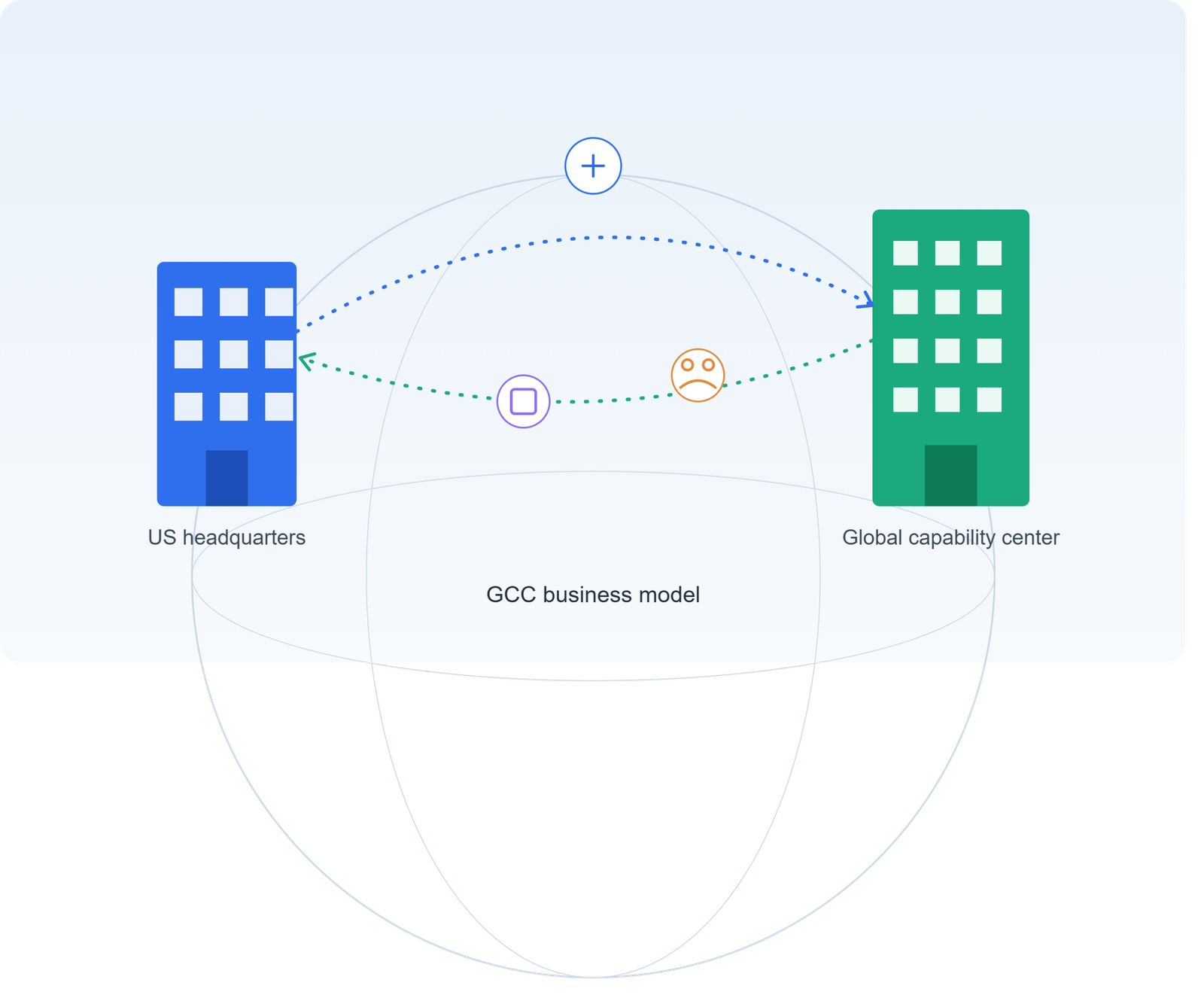
Chances are you landed here because “GCC business” kept showing up while you were reading about how big companies scale their operations overseas — and honestly, it’s not the clearest term Google throws at people. A GCC business, short for Global Capability Center, is basically a company’s own offshore or nearshore unit. It handles real, important work — technology, finance, analytics, customer operations — and the company owns it outright instead of handing that work to some outside vendor.
Below, I’ll walk through what a GCC business actually is, how it functions day to day, roughly what it costs, and why so many American companies (not just the Fortune 500 names, but plenty of mid-sized ones too) are choosing to build one rather than sign another outsourcing contract.
What Does “GCC” Mean in Business?
Short version: GCC stands for Global Capability Center. It’s a dedicated office abroad — could be India, could be Poland, could be Mexico — that a company owns and staffs with its own employees to handle functions like IT, engineering, finance, HR, or customer support.
One quick thing worth clearing up, because it trips a lot of people up: if you typed “GCC” hoping to read about the Gulf Cooperation Council (that’s Saudi Arabia, UAE, Qatar, Kuwait, Oman, and Bahrain), you’re in the wrong place — that’s a totally different topic. In corporate and business strategy discussions, GCC almost always means Global Capability Center. That’s what we’re covering here.
So what actually separates a GCC from a regular vendor relationship? A few things:
- It’s owned by the parent company, not run by a third party
- The people working there are employees of that company, full stop — not contractors passed around between clients
- It’s built with long-term capability in mind, not just to knock out a task list
- It’s woven into the parent company’s systems and culture, rather than sitting off to the side as an outside partner
How a GCC Business Actually Works
Picture it as a satellite office — just one that happens to sit somewhere with cheaper operating costs, deeper specialized talent, or hours that overlap nicely with the rest of the world. A US software company might set one up in India, or maybe Poland, staffing it with engineers, analysts, and finance people who answer to the same leadership as the folks back at HQ.
Most centers go through a fairly predictable arc as they mature:
- Foundational stage — the basics: payroll, data entry, first-line IT support
- Capability stage — real specialized work starts, like software development or cybersecurity
- Ownership stage — the team now runs entire products or processes start to finish
- Innovation stage — ideas start flowing back to headquarters, not just deliverables
By the time a GCC hits that last stage, calling it a “back office” doesn’t really fit anymore. Often it’s where a company’s sharpest technical people actually sit.
GCC vs. BPO vs. Outsourcing vs. Shared Services
Here’s where most people get tangled up. These four terms get thrown around like they’re the same thing, and they’re really not.
| Model | Who Owns It | Level of Control | Best For | Typical Use Case |
|---|---|---|---|---|
| GCC (Global Capability Center) | Parent company | High — full ownership | Strategic, long-term, IP-sensitive work | AI development, engineering, analytics |
| BPO (Business Process Outsourcing) | Third-party vendor | Low — vendor controlled | Transactional, standardized tasks | Call centers, data entry, claims processing |
| Outsourcing (General) | Third-party vendor | Low to moderate | Short-term or non-core projects | One-off IT projects, seasonal support |
| Shared Services Center | Parent company (often domestic) | High | Consolidating internal functions | Centralized HR/finance for multiple internal divisions |
If you want it in plain English: with BPO, you’re paying someone else’s company to do your work. With a GCC, you’re building your own team abroad. And shared services just means pulling similar functions — say, HR across five business units — into one internal unit, which can actually live inside a GCC.
Why US Companies Are Building GCCs in 2026
This isn’t a pure cost play anymore, though cost still matters. Here’s what’s actually pulling American companies toward this model right now.
Talent shortages back home aren’t going away. AI engineers, cybersecurity specialists, data scientists — the US just doesn’t have enough of them, and the ones who are available cost a fortune. A GCC opens the door to large talent pools in India, Poland, the Philippines, and Mexico.
The cost savings are real, but that’s not the whole story. Benchmarks put overall cost efficiency somewhere around 30–50% versus a fully US-based team. What’s more interesting, though, is that companies keep full ownership and quality control while getting those savings — something traditional outsourcing rarely delivers.
Time zones become an advantage instead of a headache. With teams spread across the globe, development and support work can run almost around the clock, which shortens release cycles more than people expect.
Data stays under your own roof. Because GCC staff work directly for the company, sensitive IP and customer data stay inside the parent company’s own governance framework — a genuine advantage in fintech, healthcare, and other regulated industries.
And it scales without the usual headaches. A GCC can grow from a 20-person pilot to a 2,000-person operation without anyone having to renegotiate a vendor contract.
What Functions Does a GCC Business Handle?
Modern GCCs rarely stick to one department. It’s common to see them running:
- Software engineering and product development
- AI and machine learning model training
- Cloud infrastructure and DevOps
- Cybersecurity operations
- Data analytics and business intelligence
- Finance, accounting, and procurement
- HR and payroll administration
- Customer experience and technical support
- Research & development
- Legal and regulatory compliance support
One thing worth knowing before you dive in: the companies that get the most out of this model usually don’t try to move everything at once. They pick one or two high-impact functions — engineering and data analytics tend to be popular starting points — get an early win on the board, and expand from there.
Real-World GCC Business Examples
A few well-known names make this easier to picture:
Microsoft runs one of its largest R&D hubs outside the US out of Hyderabad, India, focused on AI, cybersecurity, and cloud work. Goldman Sachs has built its Bengaluru GCC into one of its biggest offices globally, handling core engineering, analytics, and finance, with a second Hyderabad hub added for AI and digital transformation. Target operates a full-scale GCC in Bengaluru covering supply chain tech, data science, and digital product work.
None of these are glorified call centers. They’re engineering and innovation hubs that genuinely shape company-wide product decisions.
Cost & ROI Snapshot for a GCC Business
| Factor | Typical Range (2025–2026) | Notes |
|---|---|---|
| Overall cost efficiency vs. US-based team | 30%–50% | Includes salary, real estate, and overhead |
| Engineering role savings | 35%–55% | Higher for senior technical roles |
| Time to operational launch | 3–6 months (direct) / 60–90 days (BOT model) | Depends on entity setup and hiring speed |
| Productivity gain (cross-functional pods) | 20%–30% | When teams operate as integrated product squads |
| Typical initial team size | 20–50 employees | Before scaling into specialized pods |
Take these as industry benchmarks rather than guarantees — actual numbers shift depending on location, function, and how mature your operation already is. Run a location-specific feasibility study before you build a budget around them.
How to Set Up a GCC Business: A 6-Step Roadmap
Setting one up isn’t complicated in theory, but skipping steps here is exactly how companies end up frustrated a year in.
- Define your strategy first. Are you chasing cost efficiency, talent, innovation, or all three? That answer shapes everything downstream.
- Pick your operating model. A fully owned GCC, a Build-Operate-Transfer (BOT) partnership, or a hybrid that blends GCC ownership with some outsourcing.
- Choose the location carefully. Weigh talent supply, cost, time-zone overlap, infrastructure, and local regulation. India, Poland, Mexico, and the Philippines each bring something different to the table.
- Sort out legal and compliance early. Entity registration, tax planning, data protection rules, and local employment law all need attention before hiring starts.
- Hire leaders before you hire teams. A site leader, functional leads, an HR lead — get them in place first. Centers that skip this step tend to struggle later.
- Integrate with headquarters properly. Same tools, same workflows, shared culture — otherwise the GCC ends up feeling like a disconnected outpost instead of part of the company.
Common Mistakes Companies Make with a GCC Business Model
- Treating the GCC like a vendor — handing it only repetitive tasks kills retention and value fast
- Scaling headcount before the processes underneath it are actually stable
- Waiting too long to bring in leadership, leaving teams without clear direction
- Letting an “us vs. them” culture form between HQ and the GCC
- Skipping investment in training, which leaves skills stagnant within a couple of years
Best Locations for a GCC Business
| Location | Best Known For | Ideal For |
|---|---|---|
| India (Bengaluru, Hyderabad, Pune, NCR, Chennai) | Largest global talent pool, mature GCC ecosystem | Engineering, AI/ML, analytics, enterprise IT |
| Poland | Strong cybersecurity and engineering talent, EU time-zone alignment | Teams supporting European markets, R&D |
| Philippines | World-class English-speaking customer experience talent | Customer support, sales operations, finance ops |
| Mexico | Nearshore proximity to the US, cultural and time-zone alignment | Customer support, IT services, finance |
| Vietnam | Fast-growing, cost-competitive engineering talent | Mobile/web development, QA, DevOps |
Is a GCC Business Model Right for Your Company?
Run through this before committing:
- You’re planning growth that spans multiple years, not just this quarter
- You need talent — AI, data, engineering — that’s genuinely hard to find domestically
- Data security or compliance control actually matters in your industry
- You want extended-hours or round-the-clock coverage
- You can commit resources for at least 12–24 months before expecting full value
If none of that applies and you just need short-term, transactional help, outsourcing or a BPO relationship will probably serve you better — no need to overbuild.
GCC Business Trends to Watch in 2026
A few shifts worth keeping an eye on: hiring is moving toward AI-native roles — MLOps, automation specialists — instead of general headcount. Smaller, focused “nano” hubs in secondary cities are becoming more common as companies look for better retention at lower cost. More organizations are also spreading operations across two or more countries to manage geopolitical risk, and ESG or workforce diversity reporting is starting to show up as a real expectation for GCCs, not just a nice-to-have.
Conclusion
A GCC business isn’t just an offshore cost-cutting trick — it’s a company-owned model that gives businesses real access to global talent, tighter data governance, and room to actually innovate over the long run. For US companies dealing with talent shortages and rising costs at home, it offers a way to scale engineering, analytics, or customer experience without losing the control that traditional outsourcing tends to cost you.
Whether it’s the right move for your company really comes down to your growth stage, your industry, and how far ahead you’re planning. But for a growing list of American businesses, it’s become simply part of how they compete on a global scale.