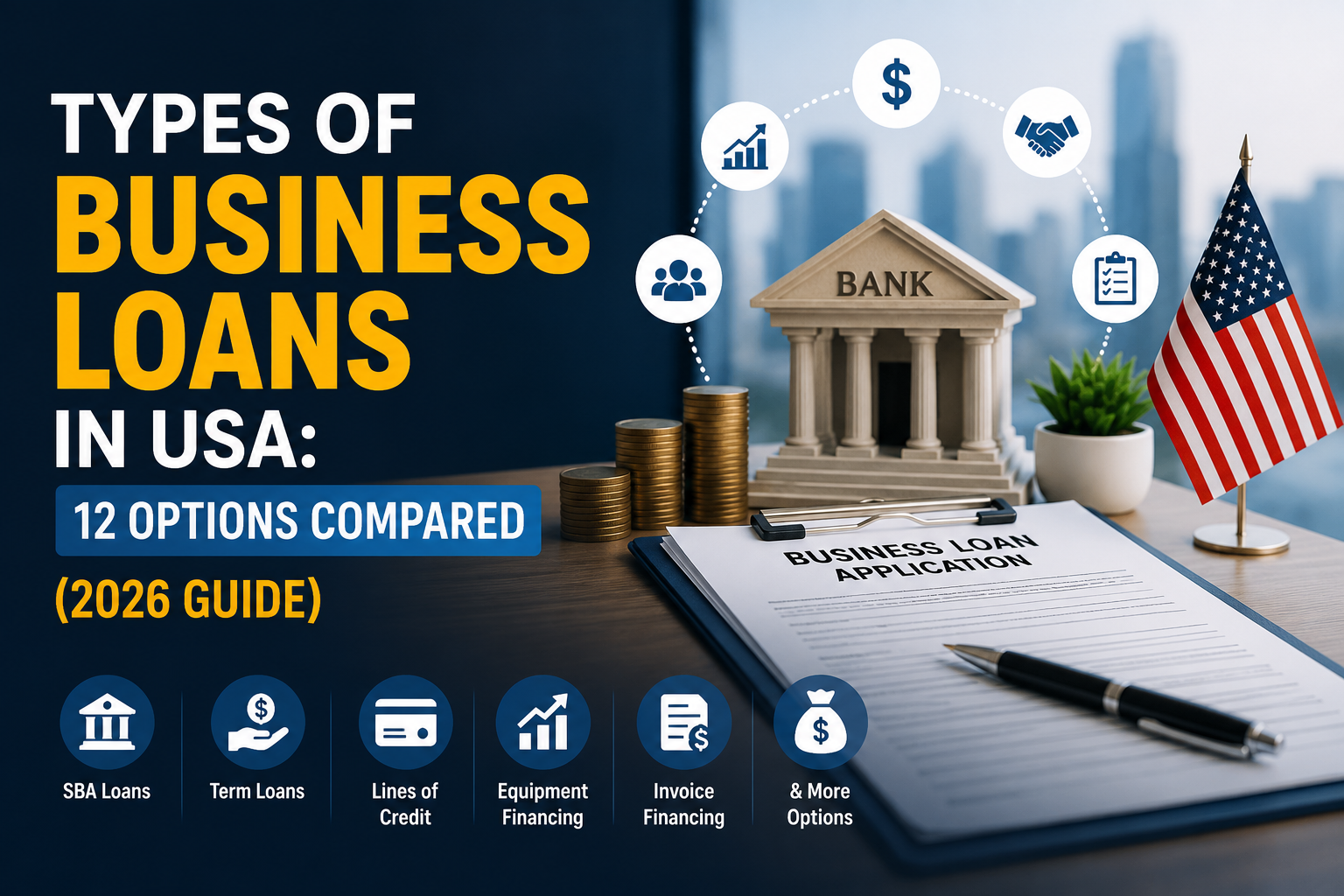
Types of Business Loans in USA”
Types of Business Loans in USA”
So you’re trying to figure out the types of business loans in USA lenders actually offer — and honestly, that’s the right first step. A lot of business owners skip this part. They walk into a bank, get offered whatever that bank happens to sell, and only later realize there was a cheaper, faster, or better-suited option sitting right there the whole time.
Here’s the thing: there isn’t a “best” business loan. There’s a best loan for your situation — how much cash you need, what you’re spending it on, how long you’ve been in business, and honestly, how much paperwork you’re willing to deal with. This guide walks through the loan types you’ll actually run into, in plain language, so you can walk into a lender’s office (or an online application) already knowing what you’re looking for.
Table of Contents
- What Are Business Loans and How Do They Work?
- 12 Types of Business Loans in the USA
- Comparison Table: Business Loan Types at a Glance
- Secured vs. Unsecured Business Loans
- How to Choose the Right Type of Business Loan
- How to Qualify for a Business Loan
- Common Mistakes to Avoid When Applying
- Expert Tips for Getting Approved Faster
- Conclusion
- FAQs
What Are Business Loans in USA and How Do They Work?
At its core, a business loan is money a bank, credit union, online lender, or government program lends your business, which you pay back over time — usually with interest tacked on. The big difference from a personal loan is what the lender actually looks at. Instead of just your paycheck, they’re digging into your revenue, how long you’ve been operating, and sometimes what assets you can put up as collateral.
Most of what you’ll come across falls into one of two buckets:
- Lump-sum loans, where you get the full amount upfront and pay it back on a fixed schedule.
- Revolving financing, where you draw money as you need it — think of a credit card — and only pay interest on what you actually use.
Once you understand that split, the rest of this guide makes a lot more sense, because almost every loan type below is really just a variation on one of these two ideas.
12 Types of Business Loans in the USA
1. SBA Loans
SBA loans get their name from the U.S. Small Business Administration, which doesn’t actually lend the money itself — it guarantees part of it, which makes banks far more comfortable offering better rates and longer terms than they otherwise would. There are three flavors worth knowing:
- SBA 7(a) loans — the workhorse of the SBA program. Businesses use these for working capital, equipment, real estate, even refinancing older debt. Amounts can run into the millions.
- SBA 504 loans — built specifically for big fixed assets like buildings or heavy machinery. These usually stack a conventional mortgage with a second, SBA-backed mortgage, plus a down payment from you.
- SBA microloans — smaller amounts, often distributed through nonprofit lenders rather than a bank directly, aimed at working capital or inventory needs.
Best for: businesses that have some history behind them and don’t mind a slower, paperwork-heavy process in exchange for better terms.
2. Traditional Term Loans
This is the loan most people picture when they hear “business loan.” You borrow a set amount, then pay it back — principal plus interest — on a fixed schedule that might run anywhere from a year to a decade or more.
Best for: businesses with decent credit that want a predictable payment and a known end date, rather than juggling a revolving balance.
3. Business Lines of Credit
Think of this less like a loan and more like a safety net. You get approved for a certain limit, and you only borrow — and pay interest on — what you actually pull from it. Pay it back, and that credit opens back up again.
Best for: businesses whose cash flow moves up and down throughout the year, or that just want something to lean on when an unexpected expense hits.
4. Equipment Financing Loans
Need a new delivery van, a commercial oven, or a piece of manufacturing equipment? Equipment financing exists for exactly that. The equipment itself usually acts as collateral, which tends to make approval a bit easier than an unsecured loan — though most lenders will still want a down payment.
Best for: contractors, restaurants, manufacturers — anyone whose business depends on expensive physical gear.
5. Invoice Factoring and Invoice Financing
If you’ve ever waited 60 or 90 days for a client to pay an invoice while your own bills kept coming due, you already understand why this exists.
- Invoice factoring — you sell your unpaid invoices to a factoring company at a discount, and they handle collecting from your customers directly.
- Invoice financing — similar idea, but you borrow against those invoices while keeping control of collections yourself.
Best for: B2B companies with long payment cycles who need the cash now, not in two months.
6. Merchant Cash Advances
A merchant cash advance hands you a lump sum in exchange for a cut of your future card sales, repaid daily or weekly. Instead of an APR, these are usually priced with something called a “factor rate” — and that’s exactly why they can end up being one of the most expensive ways to borrow money, even when the sticker price looks reasonable at first glance.
Best for: businesses with strong, steady card sales that need cash immediately and can’t wait on anything slower — but honestly, treat this as a last resort, not a first choice.
7. Commercial Real Estate Loans
These are for buying, refinancing, or renovating actual business property — an office, a retail space, a warehouse. Expect a bigger down payment here, often somewhere in the 10–30% range, with the property itself backing the loan.
Best for: businesses ready to stop paying rent and start building equity in their own space.
8. Business Credit Cards
Not technically a “loan,” but it functions like one for smaller, everyday expenses. Easier to get approved for than most financing on this list, and useful for building business credit — just watch out for the interest rate if you’re not paying the balance off monthly.
Best for: day-to-day operating costs, travel, recurring subscriptions.
9. Startup Business Loans
New businesses have a chicken-and-egg problem: you need money to build revenue, but lenders want to see revenue before they’ll lend you money. Startup loans try to bridge that gap — often through SBA microloans, online lenders, or loans that lean heavily on the founder’s personal credit and a personal guarantee.
Best for: founders who need capital before they have much of a track record to show for it.
10. Franchise Financing
Buying into a franchise comes with its own financing category, partly because franchises come with a proven business model already attached — which some lenders (including SBA-approved ones) see as lower risk than an independent startup.
Best for: anyone financing a franchise fee, buildout costs, equipment, and opening-day working capital.
11. Specialty and Minority-Owned Business Loans
There are loan programs built specifically for women-owned, veteran-owned, and minority-owned businesses, along with certain industries like agriculture or healthcare. These often come from government agencies or mission-driven nonprofit lenders and can offer friendlier terms than you’d find elsewhere.
Best for: owners who qualify under one of these specific categories and haven’t looked into it yet.
12. Nonprofit and Community Microloans
Different from SBA microloans, these come from Community Development Financial Institutions (CDFIs) — nonprofits that often pair the loan itself with business coaching or mentorship, aimed at entrepreneurs who might not fit a traditional bank’s checklist.
Best for: very small businesses, or early-stage owners who could use guidance as much as capital.
Comparison Table: Business Loan Types at a Glance
| Loan Type | Typical Loan Amount | Typical Speed | Collateral Needed? | Best For |
|---|---|---|---|---|
| SBA 7(a) Loan | Up to $5 million | Weeks to months | Sometimes | Established businesses needing flexible funding |
| SBA 504 Loan | Up to $5.5 million | Weeks to months | Yes (asset-based) | Real estate or major equipment purchases |
| SBA Microloan | Up to $50,000 | Weeks | Sometimes | Small working capital needs |
| Traditional Term Loan | $10,000–$500,000+ | Days to weeks | Often | Predictable, one-time financing needs |
| Business Line of Credit | $10,000–$250,000 | Days | Sometimes | Ongoing or seasonal cash flow gaps |
| Equipment Financing | Full/partial equipment cost | Days to weeks | Yes (the equipment) | Purchasing machinery or vehicles |
| Invoice Factoring/Financing | 70–95% of invoice value | Days | Invoices as collateral | Unlocking cash from unpaid invoices |
| Merchant Cash Advance | $5,000–$500,000 | 1–2 days | No | Fast cash for card-heavy businesses |
| Commercial Real Estate Loan | Varies by property value | Weeks to months | Yes (the property) | Buying or renovating business property |
| Business Credit Card | $1,000–$100,000 limit | Instant to days | No | Everyday operating expenses |
| Startup Loan | $5,000–$150,000 | Days to weeks | Often (personal guarantee) | New businesses with limited history |
| Franchise Financing | Varies by franchise fee | Weeks | Often | Buying into an established franchise |
Amounts, speeds, and terms vary a lot depending on the lender and your qualifications — treat this table as a general starting point, not a quote.
Secured vs. Unsecured Business Loans
This distinction comes up in almost every loan type above, so it’s worth pausing on.
Secured loans ask you to put up collateral — property, equipment, inventory, whatever the lender can claim if things go sideways. Because the lender’s risk drops, you usually get a better rate and a bigger loan amount in return.
Unsecured loans skip the specific collateral requirement, but don’t mistake that for “no risk to you.” Lenders make up for the extra risk with higher rates, shorter terms, or smaller amounts — and a lot of them still ask for a personal guarantee.
Expert tip: that personal guarantee is the part people gloss over. Even an “unsecured” loan can leave your personal assets exposed if the business can’t pay it back. Read that section of the contract twice.
How to Choose the Right Type of Business Loan
Questions to Ask Before You Apply
- How much do I actually need? Overborrow and you’re paying interest on money you didn’t need. Underborrow and you’re back here again in three months.
- What’s it actually for? Equipment, real estate, payroll, inventory — each one points you toward a different loan type.
- How fast do I need it? If the answer is “yesterday,” an SBA loan isn’t happening. A line of credit or MCA might be your only realistic option.
- Do I have anything to offer as collateral? This shapes whether cheaper secured financing is even on the table.
- Can my cash flow actually support the payment? Run the numbers against your average monthly revenue before you sign anything — not after.
Checklist: Are You Loan-Ready?
You know your personal and business credit scores
You’ve been operating for at least 6–24 months (this varies by lender)
Your monthly revenue is consistent enough to show a pattern
You know exactly what the loan will be used for
You’ve gathered your key financial documents already
You’ve compared at least two or three lenders, not just one
How to Qualify for a Business Loan
Common Eligibility Requirements
- Credit score — traditional banks and SBA lenders usually want good-to-excellent personal credit. Online and alternative lenders will work with lower scores, but you’ll pay for that flexibility in the rate.
- Time in business — some online lenders will look at six months of history; traditional banks and SBA lenders often want two years or more.
- Annual revenue — minimum thresholds are common, often somewhere between $50,000 and $250,000+ depending on how much you’re asking for.
- Debt-to-income and cash flow — lenders want proof your existing obligations won’t sink your ability to repay a new one.
- Collateral or a personal guarantee — required for most secured loans, and honestly, plenty of “unsecured” ones too.
Documents You’ll Need
- Business and personal tax returns
- Bank statements (usually the last 3–12 months)
- Profit and loss statement / balance sheet
- A business plan — especially for startups or SBA applications
- Legal paperwork: licenses, articles of incorporation, leases
- Personal ID and a personal financial statement
Common Mistakes to Avoid When Applying
- Applying everywhere at once. Multiple hard credit inquiries in a short window can actually knock your score down right when you need it strongest.
- Confusing a factor rate with an APR. This one trips up a lot of first-time borrowers, especially with merchant cash advances — the “rate” can look deceptively small until you do the math on total repayment.
- Focusing only on the monthly payment. A low monthly number can hide a much higher total cost over the life of the loan. Look at both.
- Skimming past the personal guarantee clause. Ignoring it doesn’t make it disappear — it just means you find out about it the hard way later.
- Waiting until you’re desperate to apply. The tighter your timeline, the fewer (and pricier) your options become. Apply before you’re out of runway, not after.
Expert Tips for Getting Approved Faster
- Get your paperwork together before you even start applying. Incomplete applications are probably the single most common reason for delays.
- Pull your business credit report, not just your personal one. Most owners never check it, and it can catch you off guard.
- Match the loan to the actual purpose. Lenders respond better to a specific, well-documented reason for borrowing than a vague “for general business use.”
- Get more than one offer. Even two or three quotes can reveal a real difference in rate, fees, or terms you’d have otherwise missed.
- If a bank turns you down, try a CDFI or SBA-approved lender next. They’re often set up to work with borrowers who don’t fit a conventional bank’s checklist.
Conclusion
At the end of the day, there’s no single right answer to the types of business loans in USA owners can choose from — it genuinely comes down to your business’s age, your credit, your revenue, and what exactly you’re trying to fund.
Start by getting clear on your purpose and your timeline, then match that against the loan types above. And don’t settle for the first offer you get — comparing a few lenders, whether that’s an SBA-approved bank, a credit union, or a solid online lender, is usually where the real savings show up.